50 Hours, 5 Central Banks: Your Tactical Guide to the October 28–30 Rate Decisions

Welcome back to Trade Invest Flow!
As a companion piece to our Crossroads macro report, this tactical preview breaks down the massive 50-hour central bank gauntlet running from Wednesday, October 28 through Friday, October 30, 2026.
A quick reminder on our sourcing: all bank calls, spot levels, and market-implied odds below are drawn directly from published institutional research as of late October 2026 and reflect the exact dates of those reports rather than live quotes.
Why This 72-Hour Window Matters
Five G10 central banks—the RBNZ, Bank of Canada, Federal Reserve, ECB, and Bank of Japan—step up to the podium between Wednesday and Friday.
On the surface, three of the five (the Fed, ECB, and BoJ) are widely expected to hold rates steady this week. Do not let those consensus holds lull you to sleep. Because sticky energy costs are clashing with uneven domestic demand, this week isn't just about what central banks do in October—it's about how they set the stage for December and Q1 2027.
Here is your chronological cheat sheet before we dive into the bank-by-bank dynamics:
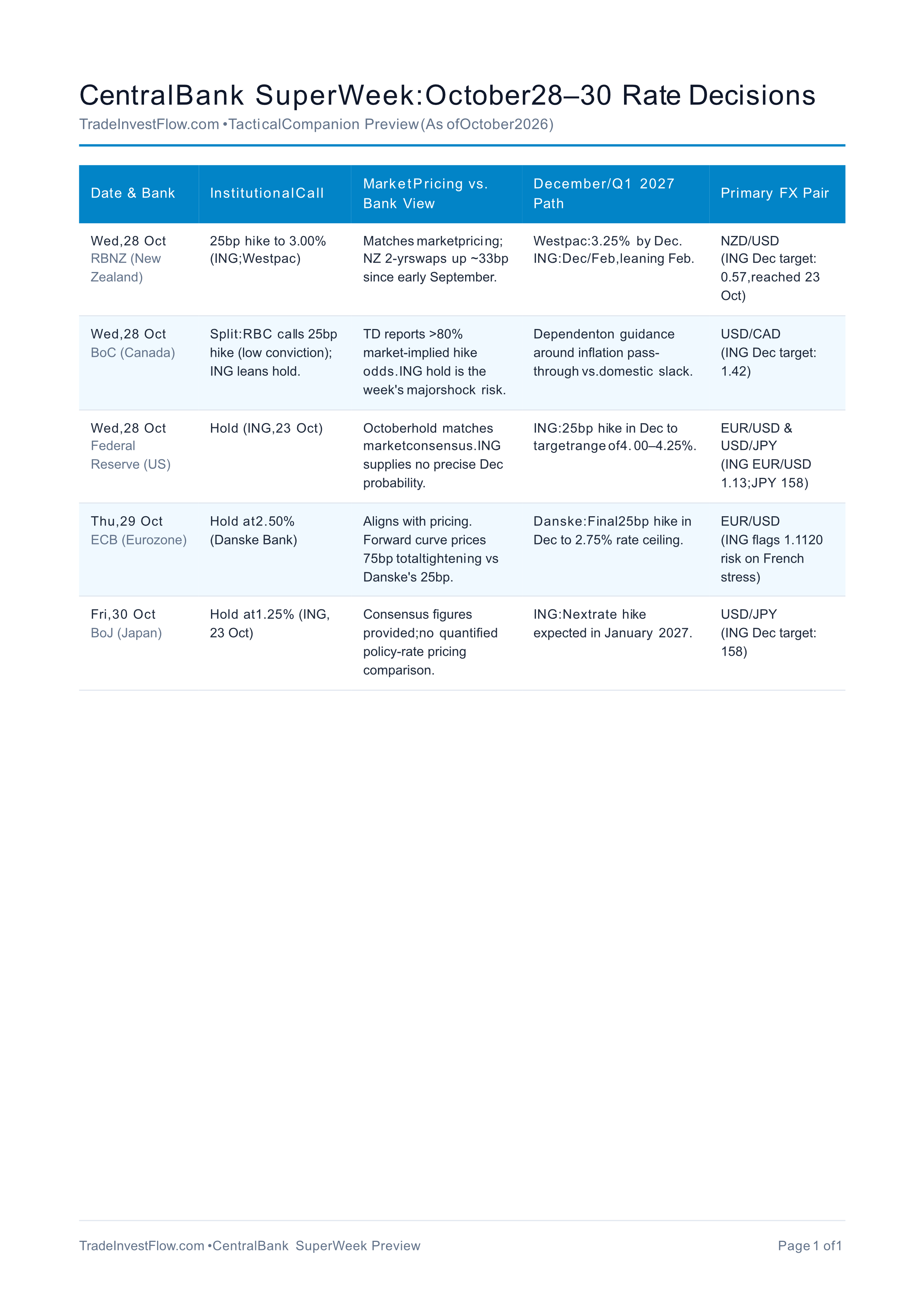
Wednesday, October 28: The Triple-Header
1. Reserve Bank of New Zealand (RBNZ): The Priced-In Hike, The Open-Ended Sequel
Both ING (23 Oct) and Westpac (23 Oct) agree with market pricing that the RBNZ will pull the trigger on a 25bp hike to 3.00% on Wednesday. With New Zealand two-year swaps already up roughly 33bp since early September and ING acknowledging on 23 October that its one-month 0.570 NZD/USD target had already been hit, the actual 25bp move is yesterday's news.
What will move the Kiwi: Watch the statement's tone on imported inflation. ING notes that expensive oil and currency depreciation are overpowering softer domestic inflation readings, leaving them slightly favoring February over December for the next hike. Westpac, by contrast, expects the RBNZ to follow up right away in December to 3.25%. If the RBNZ leans aggressively into fuel-price risks on Wednesday, Westpac's December timeline gets a boost.
2. Bank of Canada (BoC): The Biggest Surprise Risk of the Week
If you are looking for pure event volatility on Wednesday, look at Ottawa. Heading into the October 28 decision, TD (23 Oct) notes that money markets are pricing in greater than 80% odds of a 25bp BoC hike.
Behind the scenes, however, institutional economists are far less convinced:
RBC (22 Oct) officially calls for a 25bp hike, arguing policymakers simply don't want to wait around for energy-led inflation to broaden—yet RBC explicitly attaches low conviction to that call because the Canadian economy is still carrying substantial slack.
ING (23 Oct) steps away from the crowd and leans toward a hold, arguing that recent jobs and inflation numbers just aren't strong enough to justify pulling the trigger right now.
The takeaway for traders: Because the market is more than 80% priced for a hike, a 25bp increase is largely baked into the cake. If ING is right and the BoC blinks with a hold, USD/CAD (where ING carries a 1.42 December target) could see the sharpest immediate repricing of the entire week.
The takeaway for traders: Because the market is more than 80% priced for a hike, a 25bp increase is largely baked into the cake. If ING is right and the BoC blinks with a hold, USD/CAD (where ING carries a 1.42 December target) could see the sharpest immediate repricing of the entire week.
3. The Federal Reserve (FOMC): Pausing Now, Loading the Chamber for December?
Everyone agrees the Fed stays on hold on October 28, which means all eyes will be glued to Chair Powell's press conference and the committee's framing of upcoming jobs and CPI releases.
ING (23 Oct) expects the Fed to use this meeting to keep the door wide open for a 25bp hike in December, which would lift the target range to 4.00–4.25%. Their argument rests on sturdy US growth and persistent price pressures—Before lower energy shipping and insurance costs eventually ride to the rescue later on.
What to watch across assets: ING's rates strategists expect the US 10-year Treasury yield to climb back above 5% once risk sentiment stabilizes, which is a major reason ING thinks the US dollar will hang onto much of its September strength. Still, keep an eye on tech stocks: if US equities wobble again around earnings and Fed commentary, ING warns the greenback could slip against low-yielding safe havens like the yen and Swiss franc.
Thursday, October 29: The European Central Bank (ECB)
On Thursday, Danske Bank (20 Oct) expects the ECB to hold its deposit rate at 2.50%—a call that matches current market pricing. The real tension lies in what happens after Thursday.
While Danske pencils in one final 25bp hike to 2.75% in December, they point out that the forward curve has priced in 75bp of tightening across the curve (note: across the forward curve as a whole, not December-only pricing). Why does Danske think the market is overdoing it? Three reasons:
Weak underlying inflation pass-through.
Visible demand destruction from high energy prices.
Tighter fiscal conditions across the bloc.
The French Wildcard: ING (22 Oct; 23 Oct) highlights an additional headache for the ECB: French sovereign bond stress. When French bond spreads widen, they tighten financial conditions across the Eurozone automatically—acting like a stealth rate hike. While ING's December endpoint for EUR/USD sits at 1.13 (and Westpac's is at 1.14), ING warns that any flare-up in French fiscal jitters around the ECB meeting could drag EUR/USD down for an immediate retest of 1.1120.
Friday, October 30: The Bank of Japan (BoJ)
Wrapping up the week in Tokyo, ING (23 Oct) expects the Bank of Japan to hold its policy rate at 1.25% on Friday and wait until January 2027 to deliver its next rate hike.
Because Friday's decision arrives alongside a major data dump—including October 30 Tokyo CPI, retail sales, and industrial production—traders will be watching to see whether BoJ Governor Ueda sounds confident enough in domestic demand to validate that January hike window, or if currency weakness forces a sterner tone. ING maintains a December target of 158 for USD/JPY (published 15 Oct; rationale 12 Oct), though remember that a tech-led pullback in US equities remains the primary near-term catalyst that could suddenly boost the yen.
The Bottom Line for Your Trading Desk
If you only take three things into Wednesday's opening bell, make it these:
Watch Canada for the binary shock: With greater than 80% hike odds priced in (TD, 23 Oct) and even hike-callers like RBC expressing low conviction, an ING-style BoC hold is the cleanest contrarian surprise on the board.
Fade extreme Eurozone rate pricing if growth cracks: Danske's 25bp remaining-cycle view vs. 75bp priced across the curve leaves plenty of room for dovish repricing if ECB guidance emphasizes demand destruction or French bond stress.
Don't forget next week's encore: As soon as Tokyo closes on Friday, the baton passes straight to Australia—where October 28 CPI sets up Westpac's hawkish call for a 25bp RBA hike to 4.85% in November (against roughly 50/50 market odds as of 23 Oct).